The Envelope
Thursday, 20 January 2011
Oscar Predictions 2011
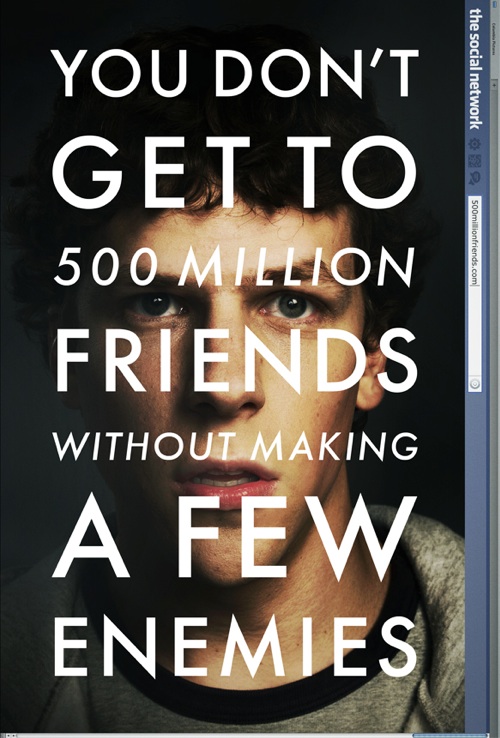
Picture: The Social Network
Director: David Fincher (The Social Network)
Actor: Colin Firth (The King's Speech)
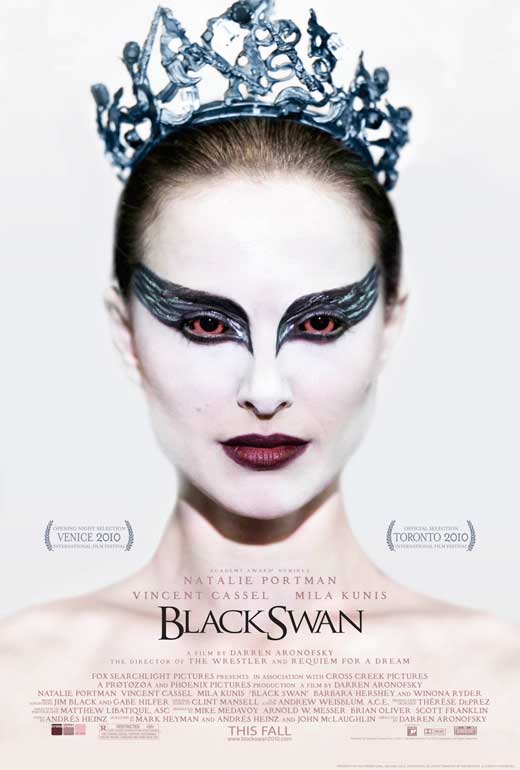
Actress: Natalie Portman (Black Swan)
Supporting Actor: Christian Bale (The Fighter)
Best Supporting Actress: Melissa Leo (The Fighter)
Best Original Screenplay: The Kids Are Alright
Best Adapted Screenplay: The Social Network
Cinematography: Inception
Animated: Toy Story 3
Saturday, 15 January 2011
Blue Valentine (2010) - dir. Derek Cianfrance *****
A wrenched portrait of a ruined marriage.
Derek Cianfrance's delicately told, painfully portrayed film about the rise and fall of a 21st century relationship might be the most difficult film to watch of 2010. This isn't to say the film isn't compelling. It is. Rather, the lead performances by Ryan Gosling and Michelle Williams as Dean and Cindy are so real that we have to pinch ourselves to remind us that this isn't a documentary we are watching. This is testament to the acting abilities of Gosling and Williams, who have firmly established themselves as two of the most talented young actors working in Hollywood. Dean and Cindy's pain is real. And we - the audience - are exposed to almost two hours of this, which can be overwhelming at times.
Blue Valentine begins in the present, where Dean and Cindy's relationship has crumbled. The only thing holding them together is their beautiful daughter. Dean is withered. Life has passed him by too quickly, and he's almost retired into the role as redundant old man, even at the delicate age of thirty-something. Cindy is the polar opposite. She is working all-hours on a nursing career, their only real source of income. Cianfrance cleverly crosscuts the present with the past. We see a totally different couple pre-marriage. Dean and Cindy are young. They love each other. Their feelings are real, if a little naive. Every new relationship begins with the honeymoon stage, and Dean and Cindy are no different. Like all romances, it's hard at first to conceive what could ever go wrong. As in life, things inevitably get in the way. For Dean and Cindy, it is a pregnancy from her previous partner that threatens to shatter their love. We learn that their daughter is actually Cindy's daughter, not Dean's. Plot twist number one. Whereas Dean seemed like a jerk in the present, we begin to empathize with him. He is bitter, and he always will be.
| Where did the love go? Michelle Williams and Ryan Gosling |
Blue Valentine should yield actor nominations for Gosling and Williams, not only for their stunningly toned down performances, but for the way they shift between past and present like two completely different characters. The Dean of old is sweet and hopeful. In the present, he is hopeless and angry. Cindy's change is even more heartbreaking, because she still clings onto the dreams of her youth, a hope that seems unattainable given her circumstances.
Cianfrance has observed with microscopic detail the decadence of a relationship. The film never feels like a "movie", rather a real-life relationship captured on camera without its characters ever knowing. It is that good of a film. Realism often falls flat because actors don't have the subtlety of concealing their trademark skills which makes them "actors", or a director places the camera too provocatively to ever give us a third-person view. Sometimes it's the screenwriter's fault for yielding to the structure of three acts, causing the narrative to seem orchestrated. Or the editor who chooses too many closeups for the sheer hell of it. In Blue Valentine's case, it is none of these. Its realism is so firmly established that its hard to believe this isn't a real-life story.
Blue Valentine isn't going to appeal to the masses. Those who go to the movies for escapism should stay clear of it. It is tragic, realistic, and sometimes too honest for us to bear. Cianfrance exposes us to the harsh realism of relationships and marriage. For two hours, we find ourselves watching fragments of ourselves, snippets of our own life that might seem difficult to watch, at times. This is what cinema should be doing - provoking us, asking us to watch, providing a powerful catharsis that make us evaluate not only the characters we are watching, but our own lives.
Thursday, 13 January 2011
It's Kind of a Funny Story (2010) - dir. Ryan Fleck and Anna Boden ****
The new tragicomedy by Half Nelson directors Ryan Fleck and Anna Boden delivers a perfect mix of laughter and comedy, not to be missed.
It's Kind of a Funny Story isn't the sort of name you want to call your movie unless you're incredibly confident, fearless, or simply too young to care. Fortunately, the exciting directing duo of Fleck and Boden are all of the above. And yes, for their sake, it is far more than just a "kind of a funny story", it is one of those indie gems that will have you leaving the theatre with a refreshing smile. Made for a miniscule budget of $8 million, the film never tries too hard to be overambitious. In an industry that often requires an A-list actor to bring in box office numbers, films like It's Kind of a Funny Story are exactly the wake-up call that Hollywood needs to realize the importance of story over stars.
The film follows Craig, a clinically depressed teenager who checks himself into an adult psychiatric ward on a Sunday morning, hoping to be cured in time for school the next day. This fundamental misunderstanding of how mental health works leads to him being committed for a minimum of five days. Craig is a fascinating character. His parents are good people, if a little indulgent. Nothing in Craig's world seems out of place. He is loved. He is supported. Yet something isn't right. Before long, he is thrust into the lives of mentally disturbed patients which make him seem more normal than he's ever felt before. One of these patients is Bobby, played by the lovable Zach Galifianakis, who shies away from his repulsively funny roles for a heartfelt and troubled one. It is these friendships that drive the movie forward, evicting a subtle change in Craig's outlook to the world.
| Zach Galifianakis as Bobby |
| Emma Roberts and Keir Gilchrist as troubled teens Noelle and Craig |
Fleck and Boden are clearly influenced by Wes Anderson's films, especially Rushmore and The Royal Tenenbaums. It's Kind of a Funny Story has that same humor and feel about it, yet it avoids any infringement on Anderson's work by maintaining a deft realism.
The film never glosses over or avoids the reality of the situation - clinically depressed and suicidal people fighting brutal inner demons. It is sad. It is funny. It is bittersweet. Fleck and Boden - just like in Half Nelson and Sugar - clearly understand their characters, and the world they find themselves in. By the end of the movie, Craig leaves the ward with a better sense of who he is, but unlike so many films where the self-revelation is insincere, his metamorphosis is grounded in absolutely reality. Granted, Craig no longer wants to kill himself in the immediate future, but as his narration states quite clearly, "this is just the beginning". The film might not be the best film of the year, or even a contender, but it's definitely one that is deserving of praise. It is a great role model to other indie films that sometimes try a little too hard to be "artsy" without needing to be. Asides from the Cohen Brothers, Fleck and Boden are the most exciting directing duo working today, and I now wait with great excitement to see where they go from here.
Monday, 10 January 2011
The King's Speech (2010) - dir. Tom Hooper ***
In another mediocre year for British cinema, we are once again left questioning why it creates so many satisfactory, if not forgettable films that fail to push the boundaries of storytelling. The King's Speech may be the best British film of 2010, but this isn't really saying much when you size it up against the heavyweights of American cinema, such as The Social Network, Black Swan, The Fighter, and True Grit. It takes a conservative look at King George VI, played flawlessly by Colin Firth, who is forced to overcome his stammer when he is made king.
There will be the majority who claim that George VI's stakes were immense - and therefore we are led to believe that Firth's stakes are equally as high. When confronted with his nemesis - to speak publicly to a nation - he must seek the help of a controversial Australian speech therapist, Lionel Logue, played by Geoffrey Rush. The interactions between the two are engaging and often comical, and both actors portray their characters with sublime ease. There isn't enough of these scenes, however. Rather, Hooper shows a couple of montages where George begins unconventional exercises to help cure his stammer. These montages are good, but they carry little substance to the King's therapy. What the film needs is more scenes between Firth and Rush, as it is these two that carry the weight of the film. In fact, the film might have been far greater had the entire narrative be set in Lionel's office. You can't help but watch The King's Speech and wonder if it would make a much better play than film. Just like Ron Howard's Frost/Nixon, which worked better on stage, The King's Speech would surely do the same given its two character narrative.
| Colin Firth as King George VI |
The subplot of the film supports this argument. It actually saps up more screen-time than George and Lionel's sessions. We are forced to watch too many scenes where George's brother, David, becomes King to the disdain of his father. Soon however, David's relationship with Wallace Simpson, Duchess of Windsor, forces him to step down from the throne, paving the way for George VI. The historical exposition that we are forced to digest felt like the first act of one of Shakespeare's historical plays. Whereas in theatre it can work, cinema doesn't offer this luxury. This may be the film's biggest flaw. The subplot features some of Britain's most acclaimed actors such as Helena Bonham Carter, Derek Jacobi and Michael Gambon. Sadly enough, they are almost redundant as they come and go without affecting the plot at all.
The King's Speech is going to be a big winner at the major awards ceremonies. Expect Firth to win best actor at the Academy Awards, and Rush best supporting actor. It is also a frontrunner for Best Picture, although if it wins, then the credibility of AMPAS should seriously be questioned. How can one reward a film that fails to take any risks over a film like Black Swan or The Social Network, which endeavors into the most daring waters of 2010 cinema. The King's Speech is just another reminder about what is wrong with British drama: flat, uninspired, and slightly negative. Of course, my opinion will be unpopular amongst the traditionalists of this country who enjoy a "good" piece of drama that satisfies their tastes without provoking their appetites. God Save them.
Thursday, 16 December 2010
The Social Network (2010) - dir. David Fincher *****
A-List director David Fincher's new film is sure to influence people and win over some more friends.
The Social Network is the most enjoyable film of 2010. It tells the story - somewhat fictitiously - of Mark Zuckerberg, the Harvard geek who became the world's youngest billionaire through the invention of Facebook. The film isn't an honest biopic of Zuckerberg - it never intends to be. Aaron Sorkin's brilliant screenplay brings a boring man's story to the screen in an awe-inspiring fashion that ranks as one of the most entertaining film's of the 21st century.
The film's opening scene shows why Sorkin has created some of the best comedy-dramas in recent years (The West Wing, Charlie Wilson's War). Here, Zuckerberg gets dumped by his sweet girlfriend Erica. Unlike conventional breakup scenes in Hollywood, that often glorify or sensationalize the moment, Sorkin maintains complete integrity over the dialogue. The conversation is awkward. It's tainted with pauses and moments that derail the inevitable. And it launches us into the meat of the film. Quickly, Zuckerberg becomes resentful of the breakup and starts a retaliatory campaign against Erica. He blogs vengefully against her, but also sets up a network where guys can rate girls against each other. This all happens within the first ten minutes of the film - and there isn't a second that lacks entertainment. Soon, Zuckerberg sees the commercial nature of online social networking, and it is this beginning that the less hateful Facebook originates from.
Zuckerberg teams up with his only friend, Eduardo Saverin, played by Andrew Garfield, whose wealthy Brazilian background fuels Zuckerberg's jealousy. Meanwhile, two alpha-male twins, Cameron and Tyler Winklevoss, plan to set up their own Harvard social networking site with the help of Zuckerberg. Zuckerberg plays them along, promising that he will help them establish this exciting endeavor. Of course, Zuckerberg has his own endeavors - far grander - which ultimately leads to the lawsuit between him and the Winklevoss twins, who are antagonized in Sorkin's script.
Fincher tells the story through various lawsuits between Zuckerberg and his rivals (not just the Winklevoss lawsuit), which lead into flashbacks from various points of view. One lawsuit is by Eduardo Saverin himself. This is perhaps the most tragic the film gets, but also the most compelling. Saverin was Zuckerberg's only friend, and the driving force behind the financial investments that Facebook relied on at the outset. Sorkin shows sympathy for Saverin - in the way he was shut out of Facebook when Zuckerberg chose Napster founder Sean Parker for his confidence and magnetism. Yet we can never hate Zuckerberg enough, for he is the most compelling figure of the 21st century. As the film reminds us, he is the reason we all spend countless hours a week on Facebook - how can we possibly hate the guy who provides us with this hobby? We can't.
The greatest irony of the film is that Zuckerberg was socially inept and could barely hang to any type of relationship, yet he was able to win over 500 million people and make Facebook into the most important social networking site in history. I've always been a big fan of Jesse Eisenberg, from his sensational performance in The Squid and the Whale, to the underrated portrayal of a bored teenager in Adventureland. In both these films, he exhibits a warm intelligence that makes him unquestionably the most likable young actor in Hollywood. In The Social Network, Eisenberg loses much of this warmth but retains the intelligence, making Zuckerberg an annoying yet fascinating young man. His arrogance and naivety is all the more compelling. He is the anti-hero who we can't get enough of. We are led to believe that it is this arrogance and coldness that was the foundation to Facebook's success.
Critics have called The Social Network a masculine movie, but this is unfair given the fact that it's much more about success than any gender-depictions. Yes, Zuckerberg is a jerk to women. But he's also the same to men. You don't have to be a certain sex or type of person to love The Social Network. There's a reason it became the best reviewed film of 2010 across the globe. It appeals to the masses, and this is refreshing in an industry where films are so heavily marketed to an audience that they lose their sense of self.
The film thrives on the environment it creates - a place where anyone with a big idea can thrive given the right circumstances. People will leave the film feeling an incredible sense of hope. This feel-good film of the year doesn't pretend to be something it's not. Fincher and Sorkin are far too experienced to let this happen. With masterful directing and writing, they have created a film so good that it's hard to think how a biopic could ever top this.
The Social Network is the most enjoyable film of 2010. It tells the story - somewhat fictitiously - of Mark Zuckerberg, the Harvard geek who became the world's youngest billionaire through the invention of Facebook. The film isn't an honest biopic of Zuckerberg - it never intends to be. Aaron Sorkin's brilliant screenplay brings a boring man's story to the screen in an awe-inspiring fashion that ranks as one of the most entertaining film's of the 21st century.
The film's opening scene shows why Sorkin has created some of the best comedy-dramas in recent years (The West Wing, Charlie Wilson's War). Here, Zuckerberg gets dumped by his sweet girlfriend Erica. Unlike conventional breakup scenes in Hollywood, that often glorify or sensationalize the moment, Sorkin maintains complete integrity over the dialogue. The conversation is awkward. It's tainted with pauses and moments that derail the inevitable. And it launches us into the meat of the film. Quickly, Zuckerberg becomes resentful of the breakup and starts a retaliatory campaign against Erica. He blogs vengefully against her, but also sets up a network where guys can rate girls against each other. This all happens within the first ten minutes of the film - and there isn't a second that lacks entertainment. Soon, Zuckerberg sees the commercial nature of online social networking, and it is this beginning that the less hateful Facebook originates from.
Zuckerberg teams up with his only friend, Eduardo Saverin, played by Andrew Garfield, whose wealthy Brazilian background fuels Zuckerberg's jealousy. Meanwhile, two alpha-male twins, Cameron and Tyler Winklevoss, plan to set up their own Harvard social networking site with the help of Zuckerberg. Zuckerberg plays them along, promising that he will help them establish this exciting endeavor. Of course, Zuckerberg has his own endeavors - far grander - which ultimately leads to the lawsuit between him and the Winklevoss twins, who are antagonized in Sorkin's script.
Fincher tells the story through various lawsuits between Zuckerberg and his rivals (not just the Winklevoss lawsuit), which lead into flashbacks from various points of view. One lawsuit is by Eduardo Saverin himself. This is perhaps the most tragic the film gets, but also the most compelling. Saverin was Zuckerberg's only friend, and the driving force behind the financial investments that Facebook relied on at the outset. Sorkin shows sympathy for Saverin - in the way he was shut out of Facebook when Zuckerberg chose Napster founder Sean Parker for his confidence and magnetism. Yet we can never hate Zuckerberg enough, for he is the most compelling figure of the 21st century. As the film reminds us, he is the reason we all spend countless hours a week on Facebook - how can we possibly hate the guy who provides us with this hobby? We can't.
| Jesse Eisenberg as Mark Zuckerbeg in The Social Network |
The greatest irony of the film is that Zuckerberg was socially inept and could barely hang to any type of relationship, yet he was able to win over 500 million people and make Facebook into the most important social networking site in history. I've always been a big fan of Jesse Eisenberg, from his sensational performance in The Squid and the Whale, to the underrated portrayal of a bored teenager in Adventureland. In both these films, he exhibits a warm intelligence that makes him unquestionably the most likable young actor in Hollywood. In The Social Network, Eisenberg loses much of this warmth but retains the intelligence, making Zuckerberg an annoying yet fascinating young man. His arrogance and naivety is all the more compelling. He is the anti-hero who we can't get enough of. We are led to believe that it is this arrogance and coldness that was the foundation to Facebook's success.
Critics have called The Social Network a masculine movie, but this is unfair given the fact that it's much more about success than any gender-depictions. Yes, Zuckerberg is a jerk to women. But he's also the same to men. You don't have to be a certain sex or type of person to love The Social Network. There's a reason it became the best reviewed film of 2010 across the globe. It appeals to the masses, and this is refreshing in an industry where films are so heavily marketed to an audience that they lose their sense of self.
The film thrives on the environment it creates - a place where anyone with a big idea can thrive given the right circumstances. People will leave the film feeling an incredible sense of hope. This feel-good film of the year doesn't pretend to be something it's not. Fincher and Sorkin are far too experienced to let this happen. With masterful directing and writing, they have created a film so good that it's hard to think how a biopic could ever top this.
Wednesday, 15 December 2010
The Kids Are Alright (2010) - dir. Lisa Cholodenko ****
Lisa Cholodenko hits top form in this heartfelt comedy about two children conceived by artificial insemination, who bring their birth father into their family. Bening looks a lock for a Best Actress nomination.
The Kids Are Alright may just be this years answer to "Little Miss Sunshine", only funnier and better acted. With mesmerizing performances by Annette Bening and Mark Ruffalo, and strong supporting roles for Julianne Moore and Mia Wasikowska, the film grows on us as it progresses into something much bigger and sadder than the premise leads us to believe.
The Kids Are Alright centers on a lesbian marriage, although it shies away from themes of homosexuality. Instead, it microscopes marriage itself, an adventure that is universally challenging and daunting - something we may not have been raised to prepare for. The couple involves Nic (Bening) and Jules (Moore), who raise an angst-ridden boy named Laser and a sweet, intelligent girl named Joni. Basically, each mother gave birth to one of the children, but the kids are half-siblings because only one sperm donor was used. That's about as complicated as the movie gets.
They are a middle-class family living in suburban Los Angeles. Nic is a hard-working doctor, while Jules flits from one job to the next. This time, she tries her hand at garden landscaping, to Nic's disapproval. Like every marriage, they're going through a mini-crisis, but this is nothing compared to what awaits them.
The comfortable home life that Nic and Jules have created is rocked when Joni and Laser decide to meet their sperm donor, without telling their parents. Their father is the lovable and relaxed Paul (Ruffalo), about as far away from Nic and Jules as you could get. Paul owns a small organic restaurant. His life is sad, yet he seems content with it. He's never been married. He's got no children. And he occasionally sleeps with one of his co-workers for sexual satisfaction.
When Nic and Jules find out about Paul, they disapprove, although their liberal exterior forces them to accept him into their lives. Paul tries to win their approval by hiring Jules to design a new garden for his house. At this moment, the adult lives' suddenly get a lot more complicated. Nic and Jules fight increasingly more, with Nic retreating to alcohol to deal with the impending stress that Paul brings. Thus, she pushes Jules further and further away. When Jules and Paul sleep together, everything is thrown into question. I mean... everything. Jules tries to come to terms with her infidelity, but she ends up sleeping with Paul daily as she finishes up his garden. Paul falls in love with Jules. Everybody loves someone else, and this setup leads to a brilliant third act when Nic discovers the shocking truth.
Cholodenko create a fascinatingly original portrait of marriage, and the consequences of children, betrayal, but ultimately, loneliness. Bening's performance is amongst the best of her career, and that's saying something when you look at her impressive resume (American Beauty, Julia and Julia). She's a lock for a best actress nomination, and it wouldn't surprise anybody if she went the full distance. It's also a breakout performance for Mia Wasikowska, who has stamped her authority as one of Hollywood's most talented young actresses. Ruffalo - as ever - is sublime. He carries the role with his lovable quality.
The true winner is Cholodenko's script - along with her writing partner Stuart Blumberg - which captures the idealism and compromises that it takes to make a marriage work. The characters are real. They are alive. Made for a miniscule $4m, The Kids Are Alright is testament that great things come in small packages.
The Kids Are Alright may just be this years answer to "Little Miss Sunshine", only funnier and better acted. With mesmerizing performances by Annette Bening and Mark Ruffalo, and strong supporting roles for Julianne Moore and Mia Wasikowska, the film grows on us as it progresses into something much bigger and sadder than the premise leads us to believe.
The Kids Are Alright centers on a lesbian marriage, although it shies away from themes of homosexuality. Instead, it microscopes marriage itself, an adventure that is universally challenging and daunting - something we may not have been raised to prepare for. The couple involves Nic (Bening) and Jules (Moore), who raise an angst-ridden boy named Laser and a sweet, intelligent girl named Joni. Basically, each mother gave birth to one of the children, but the kids are half-siblings because only one sperm donor was used. That's about as complicated as the movie gets.
They are a middle-class family living in suburban Los Angeles. Nic is a hard-working doctor, while Jules flits from one job to the next. This time, she tries her hand at garden landscaping, to Nic's disapproval. Like every marriage, they're going through a mini-crisis, but this is nothing compared to what awaits them.
The comfortable home life that Nic and Jules have created is rocked when Joni and Laser decide to meet their sperm donor, without telling their parents. Their father is the lovable and relaxed Paul (Ruffalo), about as far away from Nic and Jules as you could get. Paul owns a small organic restaurant. His life is sad, yet he seems content with it. He's never been married. He's got no children. And he occasionally sleeps with one of his co-workers for sexual satisfaction.
When Nic and Jules find out about Paul, they disapprove, although their liberal exterior forces them to accept him into their lives. Paul tries to win their approval by hiring Jules to design a new garden for his house. At this moment, the adult lives' suddenly get a lot more complicated. Nic and Jules fight increasingly more, with Nic retreating to alcohol to deal with the impending stress that Paul brings. Thus, she pushes Jules further and further away. When Jules and Paul sleep together, everything is thrown into question. I mean... everything. Jules tries to come to terms with her infidelity, but she ends up sleeping with Paul daily as she finishes up his garden. Paul falls in love with Jules. Everybody loves someone else, and this setup leads to a brilliant third act when Nic discovers the shocking truth.
Cholodenko create a fascinatingly original portrait of marriage, and the consequences of children, betrayal, but ultimately, loneliness. Bening's performance is amongst the best of her career, and that's saying something when you look at her impressive resume (American Beauty, Julia and Julia). She's a lock for a best actress nomination, and it wouldn't surprise anybody if she went the full distance. It's also a breakout performance for Mia Wasikowska, who has stamped her authority as one of Hollywood's most talented young actresses. Ruffalo - as ever - is sublime. He carries the role with his lovable quality.
The true winner is Cholodenko's script - along with her writing partner Stuart Blumberg - which captures the idealism and compromises that it takes to make a marriage work. The characters are real. They are alive. Made for a miniscule $4m, The Kids Are Alright is testament that great things come in small packages.
"Black Swan" (2010), dir. Darren Arronofsky *****
In his blistering new film, Aronofsky states his mark as one of America's most influential and exciting filmmakers.
Black Swan is not only technically the best film of 2010, but arguably the decade. Masterfully directed by Darren Arronofsky, the film is a psychological plight into the depths of despair of Nina, played perfectly by Natalie Portman. From the opening frame to the closing frame, it is a faultless display of cinema that is rarely seen these days. Sticking with his strengths, Aronofsky uses paranoia and nightmarish imagery to create a world that never feels comfortable for audience or characters. Throughout the two hours, we are not given any room to breath. We travel with Portman's Nina into a world that may or may not be what it seems. We are in the elite world of ballet, a brutal environment where back-stabbing and competitiveness lies at its forefront.
The story focuses on Nina, a ballerina who gets the role of a lifetime to play the Swan Queen in New York City Ballet's production of Swan Lake. Nina is technically perfect, and has no trouble adapting to the White Swan - innocent, beautiful and loving. However, it is the Black Swan that she cannot grasp, a role which requires less technique and more emotion. Her choreographer, Thomas (played by Vincent Cassel), a manipulative and predatory thirty-something, encourages Nina to find her dark side. In an art such as ballet, where we are led to trust our seniors, Nina doesn't call Thomas out for his unethical treatment towards her. He claims that he is helping Nina discover the tools she needs to play the Black Swan.
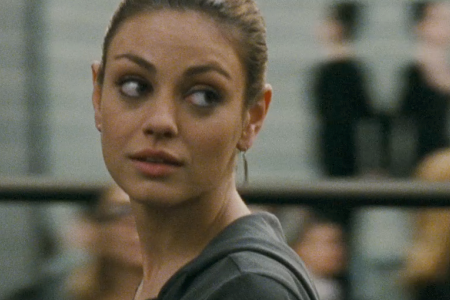
| Mila Kunis as Nina's rival, Lilly |
Aronofsky doesn't follow the cliched narrative trick that most filmmakers might take. Instead, he implies that Nina lost her mind years before we first meet her - possibly because of her mother's smothering love, or the lack of a father figure in her life.
Black Swan might be the most love or hate films of the year. Some will find it near impossible to watch as it provokes the audience's emotions on levels rarely seen these days. There are moment you have to look away, moments when the pain of Nina's body becomes to great for her - and us, the audience, who are living vicariously through Nina's eyes. For those that can take the emotional torture, it will be a cinematic experience that you won't forget anytime soon. As with Aronofsky's previous films, Black Swan is visually arresting. It captures the pain that a top ballerina goes through with their bodies. Through Aronofsky's direction, you feel every tendon stretching, every muscle working to attain perfection. However, it's not a selfishly directed him. Like in Requiem For a Dream and The Wrestler, Aronofsky hands the control to the actors. Without Portman's Oscar-worthy performance, his effort might be nothing. Portman and Kunis started ballet training six months before principal photography commences so that their bodies would match that of professional dancers. It is this focus on the body that is so effective. Nina appears almost skeletal through the film. Her muscle tone - like every other dancer in the film - is accentuated, which helps the audience emphasize the physical toll that ballet has upon the body.
As a so-called "young director", Aronofsky has clearly borrowed a great deal of material and poured it into the vision of Black Swan. Its nightmarish quality parallels Polanski's Rosemary's Baby, The Red Shoes and The Shining. Instead of copying these films, Aronofsky has spun them into his own nightmarish world, which makes him one of America's most exciting directors working today (matching Paul Thomas Anderson).
The score of the film is brilliantly done by Aronosky's collaborator, Clint Mansell, who turned Tchaikovsky's music into a haunting and dreamlike quality. The way the music meanders the audience from feeling to feeling is testament to its excellence.
Black Swan is the darkest film of the year. It is highly sexual - but never in a glorified way. The film owns too much class for it to sink into that. It is one of those rare gems that - for any cinephile out there - should not be missed.
Subscribe to:
Comments (Atom)